Mathematics begins long before children learn to calculate. It begins when they notice.
A child recognizes a pattern, sees that two quantities are the same, discovers that five can be made in different ways, or wonders what happens when one number joins another. These early observations begin mathematical thinking. Over time, children learn to recognize relationships, represent their ideas, and reason with increasing flexibility and confidence.
As part of our ongoing effort to share thoughtful resources with families, we would like to introduce several resources that offer a window into the mathematics children are exploring at school and ways to extend that thinking at home.
Numberblocks and Bedtime Math: Bringing Numbers to Life
We are thoughtful about the resources we recommend to families, particularly given the many apps, programs, and digital experiences available to young children. We recognize that each family makes its own decisions about screen time and respect those choices.
One resource we would like to share is Numberblocks, a British animated series on YouTube that introduces early mathematical ideas through stories and engaging characters. Children see numbers come to life as they count, compare, combine, and separate quantities, gradually discovering the relationships that give numbers meaning.
One reason Numberblocks caught our attention is its natural connection to the Stern Math materials we use with our youngest children. The characters are composed of individual blocks that can be combined, separated, and rearranged, much like the materials children explore in the classroom. We have also heard from parents who have noticed growth in their children’s number sense and confidence after watching the series.
We will not be watching Numberblocks at school, but families who choose to explore it at home may recognize familiar mathematical ideas. If you watch together, we encourage you to keep the conversation open and natural. You might say, “I notice something interesting,” “I wonder what would happen if…” or simply, “What do you notice?” The purpose is not to test children or lead them toward a particular answer, but to give them time to observe, make connections, and share their thinking.
Another resource worth exploring is Bedtime Math, which offers families short, engaging math challenges designed to fit naturally into everyday routines, including bedtime. Through playful questions and familiar scenarios, children are encouraged to estimate, reason, and try different approaches to a problem. Parents need not have all the answers. The value lies in wondering together, talking through possibilities, and discovering that mathematics can be part of ordinary family life.
At school, we will continue to develop these understandings through hands-on materials, conversation, and exploration.
Greg Tang: A Broader Perspective on Mathematics
For parents interested in learning more about how children develop mathematical understanding, we recommend exploring the work of Greg Tang, mathematician, educator, and children’s author. His approach emphasizes patterns, visual thinking, number relationships, and creative problem-solving. Rather than relying solely on counting or memorizing procedures, children learn to look for structure, discover efficient strategies, and understand why mathematical ideas work.
Browsing Tang’s presentations and resources can offer parents a broader perspective on the importance of number sense and the development of flexible mathematical thinking. Explore Greg Tang’s Ted Talk, Math Makes Sense, and his website, Tang Math.
Visual Guides to Mathematical Thinking
For parents interested in understanding more about the mathematics behind their children’s work, we also recommend the book Visual Guide to Math, published by DK. Its illustrations, diagrams, and accessible explanations offer a visual introduction to mathematical concepts, helping readers see how foundational ideas connect to the larger discipline of mathematics.
Several of the visual models it explores are also central to our work at TCS. These representations help children move beyond memorizing facts and procedures toward understanding why mathematics works.
Ten frames help children recognize quantities and see how numbers relate to five and ten. By recognizing familiar arrangements at a glance, children begin to develop more efficient strategies for addition and subtraction.
Number bonds make visible the many ways a number can be composed and decomposed. Understanding that numbers can be taken apart and put together in different ways supports mental mathematics and prepares children for more complex work.
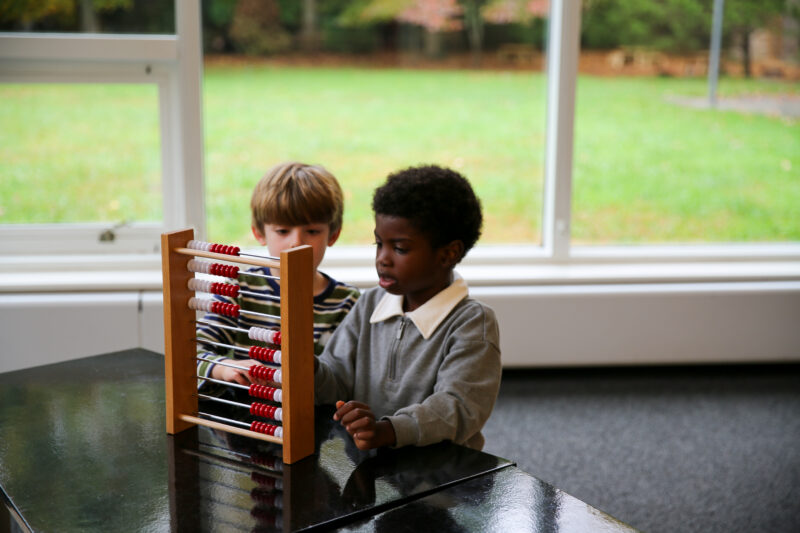
Math racks help children visualize quantities rather than count one bead at a time. By recognizing groups of five and ten, children develop fluency and a stronger understanding of number relationships.
Bar models provide a visual way to represent relationships between quantities. They help children organize information, distinguish what is known from what is unknown, and reason through mathematical problems.
Together, these tools help children develop more than computational skill. They cultivate the ability to recognize patterns, consider possibilities, explain relationships, and approach unfamiliar problems thoughtfully.
Mathematics in the World Around Us
Parents do not need special materials or formal lessons to encourage mathematical thinking at home. Patterns emerge in the arrangement of leaves on a branch. Quantity comes into view while setting the table. Measurement enters a conversation about baking, and geometry reveals itself in the shapes and structures of buildings.
These everyday encounters offer opportunities to notice, wonder, and make connections. A simple question, asked without the expectation of a particular answer, can invite a child to look more closely and share an idea.
Our hope is that these resources offer families a fresh perspective on mathematics, not simply as a subject children learn, but as a way of making sense of the world. When children begin to see patterns, relationships, and possibilities all around them, they are developing habits of mind that will serve them well throughout their education and beyond.
Maureen